
In the modern B2B landscape, business owners and marketing directors are constantly chasing the same elusive goal: more revenue. To get there, the immediate instinct is almost always to demand “more leads.” We pour thousands of dollars into paid ads, optimize our websites for search engines, and aggressively hunt for new traffic. But for many businesses, filling the top of the funnel doesn’t actually fix the bottom line. Why? Because they don’t understand the fundamental difference between lead generation and lead nurturing.
Treating these two distinct marketing phases as the same thing is like filling a bucket with holes. You might capture the attention of hundreds of potential buyers, but without a structured system to guide them, the vast majority will leak out before they ever reach the sales team. In fact, industry data shows that a staggering 80% of new B2B leads never translate into sales.
To build a sustainable, scalable growth model, you have to master both. You need the spark to start the fire, and the fuel to keep it burning. In this comprehensive guide, we are going to break down the exact difference between lead generation and lead nurturing, look at the strategies driving success in 2026, and show you how to seamlessly integrate both into your sales pipeline.
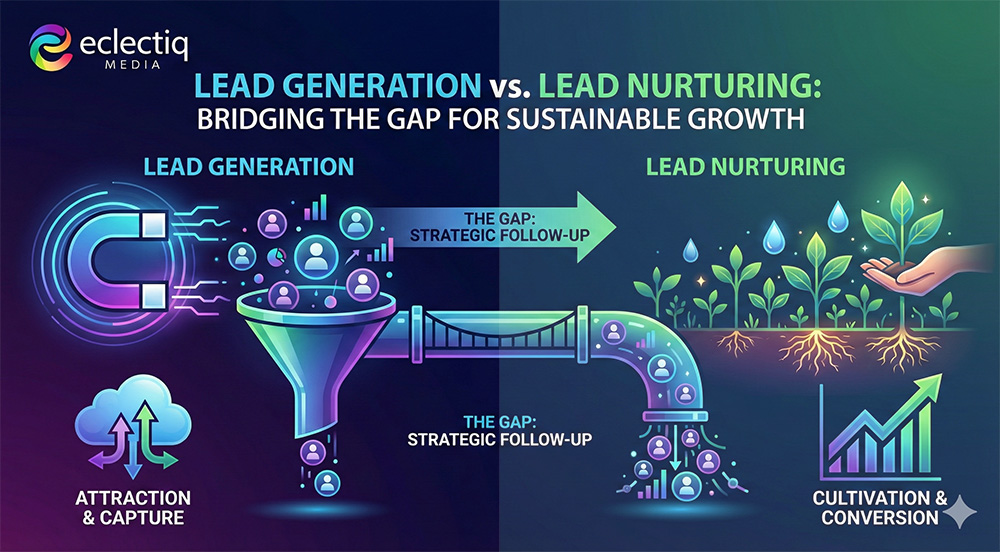
What is Lead Generation? The Art of Attraction
To fully grasp the difference between lead generation and lead nurturing, we first have to look at them in isolation.
Lead generation is the initial phase of the customer acquisition process. It is the strategic engine designed to identify, attract, and capture the interest of new potential buyers. At this stage, your target audience might not even know your company exists, or they might just be realizing they have a problem that needs solving.
The primary goal of lead generation is not immediate conversion. Instead, the objective is awareness, discovery, and obtaining permission to communicate. You are trying to turn an anonymous website visitor or a passive scroller into a known prospect by capturing their contact information (usually an email address or phone number).
Core Lead Generation Strategies in 2026
The tactics used to generate leads are highly focused on visibility and capturing intent:
- Search Engine Optimization (SEO): Creating high-quality, targeted content that ranks on Google for the specific questions your ideal buyers are asking.
- Targeted Paid Advertising: Running Google Ads to capture high-intent searchers, or using LinkedIn Ads to target specific B2B decision-makers by job title and industry.
- High-Value Lead Magnets: Offering downloadable checklists, industry reports, or free audits in exchange for an email address.
- Website Visitor Identification: Using modern software to identify the companies visiting your website, even if the user (the 98% who typically bounce) doesn’t fill out a form.
When you look at these tactics, the first half of the difference between lead generation and lead nurturing becomes clear: Lead generation is about casting a wide, yet targeted, net. It is about filling the pipeline with Marketing Qualified Leads (MQLs) who match your ideal customer profile.
What is Lead Nurturing? The Science of Conversion
If lead generation is the handshake, lead nurturing is the conversation that follows.
Lead nurturing is the intentional, strategic practice of building enduring relationships with those prospective clients at every stage of the sales funnel. Once a lead gives you their contact information, the nurturing process takes over. It involves listening to the prospect’s needs, answering their unspoken objections, and consistently providing value until they are ready to make a purchase decision.
Understanding the difference between lead generation and lead nurturing means recognizing that modern buyers—especially in B2B—do not buy on the first touch. According to recent data, buyers complete up to 80% of their research online before they ever agree to speak with a sales representative. If you go quiet during that research phase, your competitor will win the deal.
Core Lead Nurturing Strategies in 2026
Nurturing is highly personalized and relies heavily on behavioral data:
- Automated Email Drip Campaigns: Sending a sequenced series of educational emails that gradually introduce the prospect to your brand’s authority, case studies, and solutions.
- Behavioral Segmentation: Tracking what a prospect does (e.g., visiting a pricing page or downloading a specific whitepaper) and triggering customized content based on that exact behavior.
- Multi-Channel Retargeting: Showing highly specific ads (like video testimonials) to prospects who have already visited your website, keeping your brand top-of-mind across social media and the web.
- Lead Scoring: Assigning numerical values to a lead’s actions (e.g., +5 points for opening an email, +10 points for watching a video) so the sales team knows exactly when a lead is “hot” and ready to be contacted.
The second half of the difference between lead generation and lead nurturing is all about depth. Nurturing doesn’t seek new audiences; it seeks to maximize the value and trust of the audience you already have.
The Core Difference Between Lead Generation and Lead Nurturing
To make the distinction crystal clear, let’s break down the difference between lead generation and lead nurturing across four critical business pillars: Focus, Content, Goals, and Metrics.
1. Focus and Timing
- Lead Generation: The focus is external and broad. The timing is at the very beginning of the buyer’s journey (the Awareness stage). You are trying to capture the attention of people who are currently outside of your ecosystem.
- Lead Nurturing: The focus is internal and highly specific. The timing spans the middle and bottom of the buyer’s journey (the Consideration and Decision stages). You are speaking exclusively to people who have already raised their hands.
2. Content and Communication Style
- Lead Generation: Content is designed to be attention-grabbing, educational, and easily digestible. Think viral social media posts, high-ranking blog articles, and broad industry reports. The communication is mostly one-to-many.
- Lead Nurturing: Content is designed to build trust and overcome buying friction. Think in-depth case studies, ROI calculators, personalized video messages, and detailed product comparisons. The communication is one-to-one (or at least, automated to feel that way).
3. Ultimate Goals
- Lead Generation: The goal is data acquisition. Success is successfully obtaining a prospect’s name, email, phone number, and consent to contact them.
- Lead Nurturing: The goal is pipeline velocity and revenue. Success is moving that prospect smoothly from a hesitant researcher to a confident, paying customer.
4. Metrics of Success
When evaluating the difference between lead generation and lead nurturing, you have to look at different dashboards.
- Lead Generation: Measured by Website Traffic, Cost Per Click (CPC), Cost Per Lead (CPL), and total Number of Leads Generated.
- Lead Nurturing: Measured by Email Open Rates, Click-Through Rates, Lead-to-Opportunity Conversion Rate, and ultimately, Customer Acquisition Cost (CAC) and Revenue.
The Analogy: Think of your marketing strategy like a retail store. Lead generation is the window display and the sign spinning on the sidewalk—it gets people to walk through the front door. Lead nurturing is the highly trained sales associate who greets them, asks about their specific needs, guides them to the right aisle, and helps them confidently make a purchase.
The Cost of Ignoring the Difference
A massive mistake businesses make is prioritizing generation while completely neglecting the nurturing phase. They assume that if someone downloads an eBook, they are ready to buy a $10,000 service the next day.
When you fail to understand the difference between lead generation and lead nurturing, you end up annoying your prospects. Hitting a brand-new lead with a hard sales pitch is the fastest way to get them to hit the “unsubscribe” button.
On the flip side, the data proving the value of lead nurturing is undeniable. Companies that excel at lead nurturing know the difference between lead generation and lead nurturing, and generate 50% more sales-ready leads at a 33% lower cost. Furthermore, nurtured leads make purchases that are, on average, 47% larger than non-nurtured leads.
Because nurtured leads have been educated over time, they trust you more. They understand your value proposition, they have seen your case studies, and they aren’t going to haggle you on price. By the time they get on a sales call, the hard work is already done.
2026 Trends: The Convergence of Generation and Nurturing
While the difference between lead generation and lead nurturing remains structurally important, the most successful marketing teams in 2026 realize that the two must be seamlessly integrated. You cannot build a nurturing strategy after the leads have arrived; it must be designed before the first ad is even launched.
Here are the modern trends reshaping how we handle the handoff between generation and nurturing:
Intent-Based Personalization
We are far past the days of generic “Hi [First Name]” emails. Modern nurturing uses AI to track a lead’s behavior and dynamically change the follow-up content. If a lead generated from a LinkedIn ad spends three minutes reading your pricing page but doesn’t buy, an automated trigger will instantly send them an email featuring a customized ROI calculator and a case study from their specific industry.
Video-First Engagement
In a digital world crowded with AI-generated text, human connection is the ultimate currency. B2B buyers want to know who they are doing business with. Incorporating video into the nurturing process—whether through personalized screen recordings, behind-the-scenes agency tours, or video testimonials—drastically reduces the sales cycle. Video proves that there is a real, competent team behind the digital storefront.
Speed to Lead
The difference between lead generation and lead nurturing shrinks to almost zero in the first five minutes. Research shows that if you do not follow up with an inbound lead within five minutes, your chances of qualifying them drop by a staggering 80%. Automated nurturing sequences bridge this gap, ensuring that every single lead gets an immediate, relevant, and engaging touchpoint the second they enter your system.
How eclectiq MEDIA Bridges the Gap
Understanding the difference between lead generation and lead nurturing is only half the battle; executing it flawlessly is where the real growth happens. Many agencies will gladly take your money to run ads, generate a spreadsheet of cold names, and then leave you to figure out how to close them.
At eclectiq MEDIA, we understand the difference between lead generation and lead nurturing, and know that generating a lead is only the first step. Handing a local business owner a list of unconverted leads isn’t growth; it’s just creating more administrative work.
That is exactly why we provide comprehensive lead nurturing services for every single client as a foundational part of our Video Ad Growth Engine.
We don’t believe in the “leaky bucket” approach. Our Video Ad Growth Engine is designed to completely close the loop between the first click and the final sale. Here is how we integrate both sides of the strategy:
- High-Impact Generation: We use scroll-stopping, highly targeted video advertisements across social media to capture the attention of your ideal local clients. We don’t just optimize for clicks; we optimize for intent, bringing the right people into your ecosystem.
- Strategic Nurturing: The moment a lead engages, our nurturing systems take over. We utilize a multi-touchpoint strategy that leverages educational follow-ups, targeted retargeting ads, and automated relationship-building sequences.
- Building Trust at Scale: Because our engine is heavily driven by video, your prospects are constantly seeing your face, hearing your expertise, and experiencing your brand’s authority. By the time our nurturing sequences guide them to your calendar or inbox, they feel like they already know you.
We understand the true difference between lead generation and lead nurturing: Generation starts the conversation, but nurturing secures the revenue. By baking both into our Video Ad Growth Engine, eclectiq MEDIA ensures that your marketing budget isn’t just buying attention—it’s buying sustainable, measurable growth.
Final Thoughts: Stop Choosing, Start Integrating
The debate shouldn’t be about which strategy is more important. The definitive difference between lead generation and lead nurturing is simply their place in the timeline of your buyer’s journey. One attracts the audience; the other converts the audience into confident, loyal clients.
If your business is struggling with low close rates, constantly haggling over price, or feeling like your ad spend is disappearing into a void, it isn’t because you need more leads. It is because you need a better way to nurture the ones you already have.
Stop treating your leads as mere transactions. Start treating them as relationships waiting to be built.
Stop Losing Leads to a Leaky Funnel
Understanding the difference between lead generation and lead nurturing is just the first step. To actually scale your revenue, you need a system that actively cultivates those relationships. In fact, according to ongoing industry research compiled by HubSpot, properly nurtured leads produce a 20% increase in sales opportunities compared to non-nurtured leads.
At eclectiq MEDIA, our Video Ad Growth Engine is built to handle both sides of the equation. We don’t just capture high-intent local traffic; we build the automated follow-up systems that nurture those prospects until they are confident and ready to buy.
Don’t let your next great client slip away to a competitor simply because they weren’t ready to purchase on day one.
Give us a call at 971-266-1338 or contact us today to start building a growth strategy that actually converts.